Proportional Ranked Choice Voting Example
Please note that this content was published several years ago and some of the information may not be updated. For up-to-date information on election reform, see our pages on ranked choice voting and proportional representation.
Proportional ranked choice voting (also commonly known as “single transferable vote”) gives voters the option to rank candidates in order of preference and maximizes the effectiveness of every vote to ensure that as many voters as possible will help elect a candidate they rank highly. It minimizes wasted votes and the impact of tactical voting, allows voters to have more choices, and encourages positive campaigning and coalition-building. It upholds both the principle of majority rule and of fair representation of those in the minority. Because of its proven history, its emphasis on candidates rather than parties, and its ability to allow voters to express their full, honest preferences on their ballots, ranked choice voting is the gold standard for multi-winner elections in the United States.
This page demonstrates an example of how proportional RCV votes are counted.
Join us today Join us today Join us today Join us in our missionJoin us today Join us today Join us today Join us today Join us today Join us today Join us today Join us today Join us today Join us today Join us today Join us today
To Vote
Voters have the option to rank candidates in order of preference, just like in single-winner RCV.
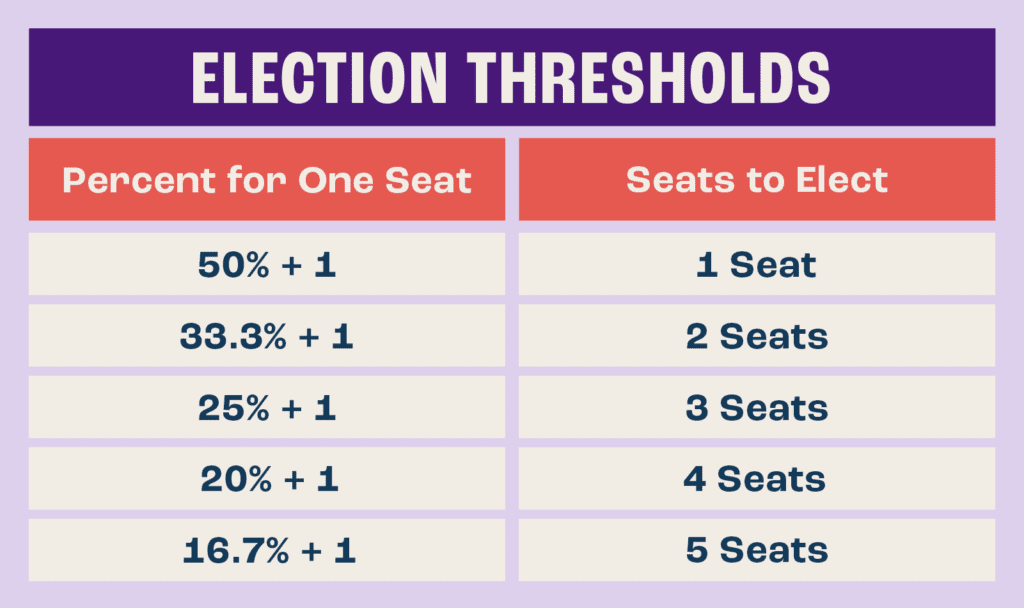
To Determine the Election Threshold
All candidates who cross the election threshold win a seat.
The threshold to elect a candidate depends on the number of seats to fill. It is the minimum number of votes required to fill all seats, while also ensuring no additional candidates can earn enough votes to cross the threshold. The mathematical formula is called the Droop Quota.
To Determine the Winners
To find out who wins, votes are counted in a series of rounds to ensure that as few votes as possible are wasted. In each round, one of two things happens: either a winning candidate is identified and elected, or the candidate in last place is eliminated.
Initially, every ballot counts for its first choice only. If enough candidates have crossed the threshold so that every seat is filled, then those candidates win and the vote counting is over. Otherwise, votes are counted in rounds as follows:
- If any candidates have more votes than the election threshold, they are elected.
- If any winning candidates earned more votes than the threshold, the surplus votes are transferred to those voters’ next choices. Before computerized tabulation, the ballots to be transferred were selected randomly from the batch of ballots originally counting for the elected candidate(s). Now, the most common method is fractional transfer. This works by adding a fraction of each vote for the elected candidate to the totals of the candidate ranked next. For example, if a candidate gets 10% more votes than the election threshold, every one of their voters will have 10% of their vote count for their next choice. That way, voters aren’t punished for honestly ranking a very popular candidate first.
- If there are no surplus votes to transfer and all seats are not filled, the candidate with the fewest votes is eliminated. When a voter’s top choice is eliminated, their vote instantly counts for their next choice who is still in the race. That way, voters aren’t punished for honestly ranking their favorite candidate first, even if that candidate cannot win.
- After eliminating the last-place candidate, return to step 1 to check whether any new candidates have crossed the threshold. Repeat steps 1-3 until all seats are filled.
The following flow chart summarizes the process:

Example
In this section, we will walk step-by-step through a hypothetical election with six candidates who are running for three seats. Three candidates are Democrats and three are Republicans. The district is majority Democratic; the Democratic candidates collectively earn 60% of first choices. However, there are a substantial number of voters who prefer the Republicans.

With 9,200 voters, the election threshold is 2,300 votes (25% of 9,200). In reality, the threshold is one vote higher than 25%, or 9,200. For this example, we keep the math simple by rounding it to 9,200.
Round 1: Armando Perez has more votes than the threshold and wins the first seat.
A count of first choices elects the most popular Democratic candidate, Armando Perez. Perez has 200 more votes than the threshold, so 200 votes will transfer to other candidates.
This will work by transferring 8% of every Perez voter’s ballot to its next choice (because Perez’s 200 surplus votes divided by his 2,500 total votes = 8%). Here are the second choices of the 2,500 voters who ranked Perez highest:
- 1,250 ranked Cathy Chan next. When those ballots are weighted at 8%, that’s 100 votes that transfer to Chan (1,250 * 8% = 100)
- 1,000 ranked Brad Jackson next. When those ballots are weighted at 8%, that’s 80 votes that transfer to Jackson (1,000 * 8% = 80)
- 250 ranked Republican Hannah Murphy next. When those ballots are weighted at 8%, that’s 20 votes transferred to Murphy (250 * 8% = 20).
- When 8% of total ballots are transferred to other candidates, Perez keeps the remaining 92% which puts him right at the threshold, but not above it.
Round 2: June Smith has the fewest votes and is eliminated.
After Perez’s votes transfer to their next choices, no candidate is above the threshold. As a result, the last-place candidate, June Smith, is eliminated. Ballots that counted for Smith are transferred to their next-highest-ranked choices. Of the 1,000 voters who ranked Smith highest:
- 580 ranked Murphy next
- 300 ranked Lorenzo next
- 100 ranked Chan next
- 20 ranked Jackson next.
Round 3: Brad Jackson has the fewest votes and is eliminated.
After the ballot transfer in round 2, no new candidate is above the threshold. The last-place candidate, Brad Jackson, is eliminated and those ballots are added to the totals of their next-highest-ranked choices. Of the 1,450 ballots that counted for Jackson,
- 1,250 transfer to Chan (meaning they ranked Chan highest among the remaining active candidates)
- 150 transfer to Murphy
- 50 transfer to Lorenzo.
Some of these voters may have ranked Perez or Smith next, but those candidates are no longer active because they have been elected or eliminated. They do not receive any more vote transfer. Ballots that would count for them move on to their next choice instead.
Reminder: Jackson’s total in round 3 included some fractional votes that we transferred in step 1. Eighty of Jackson’s votes are not whole votes; they are 1,000 votes weighted at 8% that we transferred after Perez was elected. When they transfer again upon Jackson’s elimination, they continue to transfer as 1,000 votes weighted at 8% each, for a total value of 80 votes.
Round 4: Cathy Chan has more votes than the threshold and wins the second seat.
After receiving the lion’s share of back-up support from fellow Democrat Brad Jackson, Cathy Chan is well over the threshold and is elected. She has 900 more votes than the threshold, so 900 votes will transfer to other candidates.
This will work by transferring 28.125% of every vote (or partial vote) counting for Chan to its next choice (Chan’s 900 surplus votes divided by her 3,200 total votes = 28.125%).
Reminder: Some of Chan’s ballots are already fractional because they were transferred to Chan in round 1 after we Perez was elected. 100 of Chan’s ballots are, in fact, 1,250 ballots weighted at 8% each. When these ballots get transferred again, they’re re-weighted. The new weight of that set of ballots is 28.125% of 8%, or 2.25%. This means voters who have already had their ballot count for Perez and Chan have been de-weighted twice — those voters have already elected two candidates of choice so they’re considered more “represented” at this point than ballots who have not yet elected anyone.
Of the 3,200 ballots counting for Chan:
- 50% ranked Murphy next, so Murphy gains 450 ballots (28.125% of 50% of 3,200)
- 10% ranked Lorenzo next so Lorenzo gains 90 ballots (28.125% of 10% of 3,200)
- 40% did not rank any other active candidates. As a result, 360 votes (28.125% of 40% of 3,200) are inactive and do not contribute to any other candidates.
Round 5: Hannah Murphy has more votes than the threshold and wins the last seat.
After Chan’s ballots transfer to their next choices, Hannah Murphy has more votes than the threshold and wins the last seat. Because all three seats have been filled, the vote counting can now end; there is no need to transfer Murphy’s surplus support.
Final Results: The winners are Democrats Armando Perez and Cathy Chan and Republican Hannah Murphy
The winners are Perez (D), Chan (D), and Murphy (R). If this were a single winner election, the most mainstream Democrat (Perez) easily would have won, leaving all others unrepresented. Instead, two additional candidates are elected, both of whom are rewarded by coalition-building among the district’s remaining center-left and center-right populations. Voters were split 61% Democratic and 39% Republican by first choices, and they elected 67% Democrats and 33% Republicans. In the end, 96% of voters can point to a candidate whom they supported and helped elect.
Had these three seats been elected by block voting, in which every voter casts three votes for the three candidates they support, the Democrats would have almost certainly swept all three seats, because each Democratic voter could vote for all three Democratic candidates. In fact, even if the three seats were elected by the single vote system, a weaker form of fair representation voting, Democrats still would have swept all three seats due to the Republican vote being split among three candidates.
Had these three seats been filled by dividing the district into three single-winner districts, the outcome would depend on how the district lines were drawn. The districts could have been drawn to elect two Democrats and one Republican, or they could have been gerrymandered to over-represent either party. Regardless, the district elections would probably not be competitive, and each district’s primary election would likely weed out the candidates who won by coalition-building.
By using proportional RCV to elect three seats, the election results fairly represent the district’s diversity after a competitive election without any opportunity for partisan gerrymandering.