A Path Forward for Voting Rights: State Voting Rights Acts
Earlier this month, my colleague Ryan Suto wrote a first post about voting rights history in the context of Black History Month, focusing on the concerning, historically inaccurate, and increasingly embraced idea that the Constitution is somehow “race-blind.” That concern may come to a head in Merrill v. Milligan, for which the United States Supreme Court heard oral arguments on October 4, 2022. There will likely be a decision this summer. In Merrill, impacted voters sued the State of Alabama alleging the state’s congressional and legislative redistricting plans were racially discriminatory.
The groups argued the maps diluted the voting strength of Black voters by packing a large number of Black voters into a single district and dividing the remaining Black voters across multiple districts. In short, the petitioners argued these maps were discriminatory because they denied Black voters the opportunity to elect representatives of their choice.
The case’s history at the Supreme Court began in February 2022, when the Court overturned a lower court’s preliminary injunction halting the implementation of Alabama’s redistricting plans. Because injunctive relief was granted prior to an upcoming election, the Supreme Court’s decision was not particularly surprising. The so-called Purcell principle limits the authority of federal courts to change election rules just prior to an election in order to avoid confusion and election administration issues.
Among other things, the Purcell principle requires plaintiffs to show “the underlying merits are entirely clearcut in favor of the plaintiff….” In his February 2022 concurring opinion, Justice Kavanaugh posited the plaintiffs could not establish that the underlying merits were in their favor. He further questioned whether the merits of the case were supported by the Voting Rights Act and the Equal Protection Clause. Justice Kavanaugh’s words were viewed with great concern by many voting rights advocates as a clear indication that the Supreme Court majority might not be committed to upholding the Voting Rights Act.
The Court’s decision to take the case on its merits this term, as well as the October 2022 oral arguments, only add to that concern – the Court’s majority seems inclined to shrink the scope of the VRA, in a way that makes it more difficult for Black voters to elect representatives of their choice.
On February 21, 2023, this concern was further heightened when the Supreme Court refused to hear, on appeal, a Voting Rights Act case out of Mississippi, Buck v. Watson. In Buck, a group of Black voters alleged the Mississippi legislature’s congressional redistricting plan packed them into a single congressional district, which, similar to Merrill, effectively denied Mississippi’s Black voters the opportunity to elect a representative of their choice.
Congress’s failure to pass the John Lewis Voting Rights Advancement Act along with the Supreme Court’s actions in Merrill and Buck are alarming. Justice Kavanaugh’s concurrence in denying the Merrill injunction last year is a clear signal that what protections remain at the federal level for minority voters are at significant risk.
The John Lewis Voting Rights Advancement Act would have restored protections by reinstating Section 5 of the Voting Rights Act. However, it is clear that federal protections are unlikely to be restored in the near term, which leaves states solely responsible for protecting the voting rights of their residents.
Absent federal protections, the passage of state-level voting rights acts are the most effective tool to protect and promote the franchise of all Americans. Since California passed the first state Voting Rights Act in 2001, New York, Washington, Virginia, and Oregon have passed their own state VRA legislation. This year, Connecticut, New Jersey, and Maryland are considering the adoption of state VRAs while New York is considering significant amendments to their existing law.
President Ronald Reagan once said, “The right to vote is the crown jewel of American liberties, and we will not see its luster diminished.” Thanks to the work of organizations such as the Campaign Legal Center and the NAACP Legal Defense Fund, the best state VRA legislation, like that adopted by New York last year, can maintain the core protections of the federal VRA and expand those protections by:
- Including preclearance provisions for local governments with a history of discriminatory voting practices;
- Creating stronger protections against voter suppression activities;
- Establishing additional legal protections against discriminatory voting practices;
- Expanding language assistance programs for voters with limited English proficiency; and
- Requiring election laws to be interpreted in a pro-voter way.
No matter their version or state, each of these acts and proposed legislation will ensure the right to vote remains the crown jewel of American democracy.
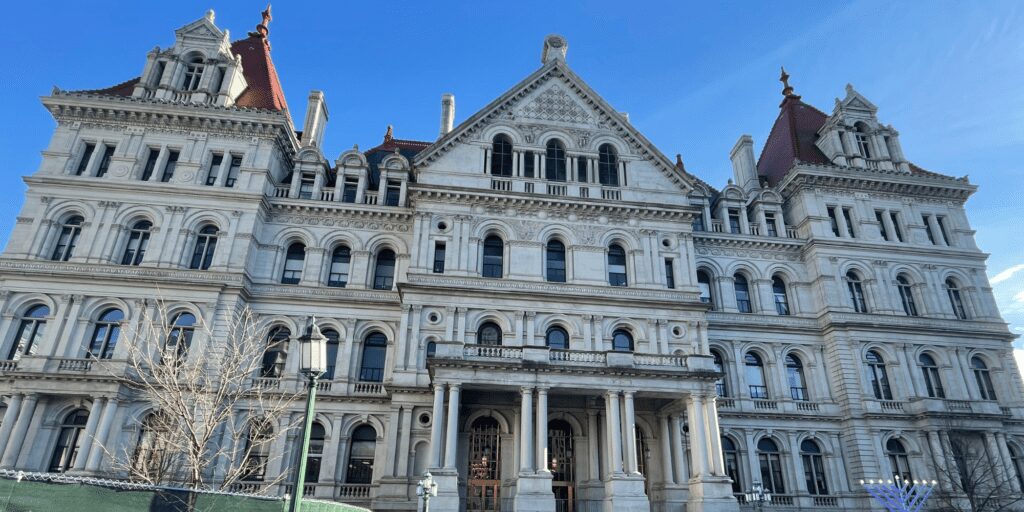
Image of the New York State Capitol by Matthew Oberstaedt