A big night for ranked choice voting
After yesterday’s midterm elections, I write to reflect on this exciting moment for ranked choice voting (RCV).
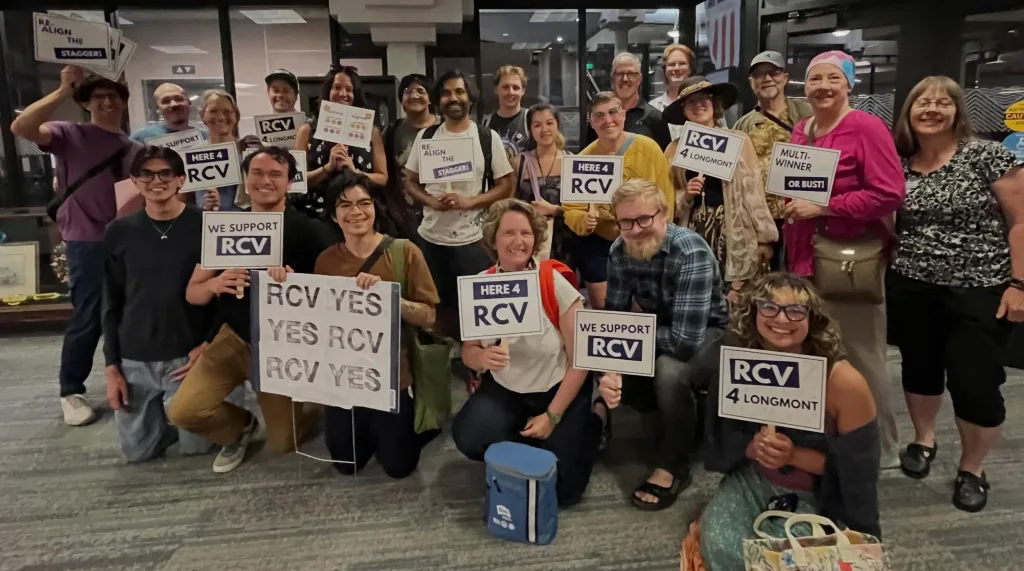
First and foremost, a ballot measure to adopt RCV has passed in Longmont, CO. Measures to keep or adopt RCV are leading in Alaska and Irvine, CA – we will continue to update you on these exciting results in the coming days.
Voters in Alaska, Maine, and 14 cities and counties used RCV to elect members of Congress, a governor, legislators, mayors, and more. More broadly, American voters are clearly hungry for change – and a new wave of elected officials in city councils, state legislatures, and Congress could offer new opportunities to win our reforms.
Americans want elections that work for them, and a government that puts people above politics. Ranked choice voting can deliver just that.
In 2016, just 10 cities used ranked choice voting. Now that number looks likely to grow to 50+ cities, counties, and states home to over 17 million Americans across the nation.
I’m delighted to share my FairVote colleagues’ initial takeaways from yesterday’s elections. Stay tuned for more updates in the coming days – including the final results of RCV ballot measures.
Ranked choice voting ballot measures
Ranked choice voting was on the ballot in three cities. It has passed in Longmont, CO and is currently leading in Irvine, CA.
If the Irvine measure continues on its current trajectory, RCV will have won in 36 of the last 38 city ballot measures. Unfortunately, an RCV measure in Honolulu – one of 20 on the ballot in the Aloha State’s capital – was defeated.
RCV is also leading in a statewide measure in Alaska, 52-48%. We’ll be in for a wait on this one – Alaska accepts absentee ballots for 15 days after Election Day. In 2024, in a failed attempt to repeal RCV and open primaries, our side did not take the lead until the 13th day. We are in a stronger position this time around.

To learn more about these successful ballot measure campaigns, visit Voter Choice Irvine, Ranked Choice Voting for Longmont, and No on 2.
Ranked choice voting in Alaska
Alaska used ranked choice voting for its U.S. House, U.S. Senate, gubernatorial, and state legislative elections. The state has counted 77% of ballots so far, and initial results show Democrat Mary Peltola leading for U.S. Senate, Republican incumbent Nick Begich leading for U.S. House, and Democrat Jonathan Kreiss-Tomkins leading for governor. VoteHub has called the governor’s race for Kreiss-Tomkins, using the cast vote record released by the state.
This afternoon, FairVote published unofficial RCV tallies using the cast vote record. We hope you’ll take a look at how these RCV elections are progressing.
Preliminary results of Alaska’s gubernatorial election
As noted above, final results in Alaska could take up to 15 days due to the state’s size and geography. The delayed results are not due to ranked choice voting; we have preliminary RCV results, and the state has a long history of slow results in any close race. Read more about when to expect results in Alaska.
Other ranked choice voting elections
Washington, DC used ranked choice voting for congressional delegate, mayor, DC Council, and other local offices. This was DC’s first time using RCV for a general election, and turnout was higher than the last open mayoral election in 2014.
Maine used ranked choice ballots in its U.S. Senate and 2nd Congressional District elections. Read FairVote’s analysis of the initial results from Maine.
Multnomah County, OR used RCV for the first time to elect its Commission chair and District 2 commissioner. Thanks to RCV, tens of thousands of voters who supported long-shot candidates will still have their voice heard in the choice between the top finishers – including 34,682 voters in the Commission Chair race.
Multnomah County Commission chair election results
| Candidate | Round 1 | Round 2 |
|---|---|---|
| Shannon Singleton | 101,878 (47%) | 115,854 (56.24%) |
| Julia Brim-Edwards | 69,424 (32.03%) | 90,130 (43.76%) |
| Sharon Meieran | 44,860 (20.7%) | Eliminated |
| Write-ins | 591 (0.27%) | Eliminated |
Boulder, CO and Portland, OR both used RCV for the second time. Portland uses the proportional form of RCV, electing three Council members per district; in Districts 3 and 4, more than 75% of voters will help elect a winner.
These cities and counties also showed that RCV results can be released just as quickly as results in non-RCV elections. Portland and Multnomah County released initial results – including RCV tallies – less than 15 minutes after polls closed. Boulder and San Francisco did the same less than half an hour after polls closed.
Other notable election results
Nationwide, the midterms showed why ranked choice voting and proportional representation are so important. Most Americans did not get to vote in competitive races for U.S. House. And in Mississippi’s razor-thin Senate race, the winning candidate will likely have less than 50% of voters behind them. Learn more about why so few elections are competitive, and how election reforms can solve the problem.
What comes next for ranked choice voting?
November 3 was a big day for ranked choice voting, and the wave of new elected officials at all levels of government means even more opportunities are on the horizon.
FairVote is readying to engage with the new Congress, state legislatures, and city councils in the new year, and our research team is hard at work analyzing the results of this year’s elections.
Ranked choice voting works, and FairVote will continue working to bring this reform to every American.